


rethinking fourth wall as a photographer

Updated: Mar 18
The question of whether the photographer is "on the stage" or "creating the stage" highlights a profound blurring of the fourth wall, where the artist fluctuates between the architect of a scene and a performer within it. In theatrical terms, the fourth wall traditionally separates the "staged" reality from the "observing" reality. However, modern practitioners often dissolve this boundary. When a photographer creates the stage, they act as a scenographer or director, manipulating the environment to reflect a subjective truth. As Fried (1980) suggests in his analysis of "absorption," the most successful art often appears unaware of the beholder, creating a self-contained world where the artist—as creator—disappears into the construction.
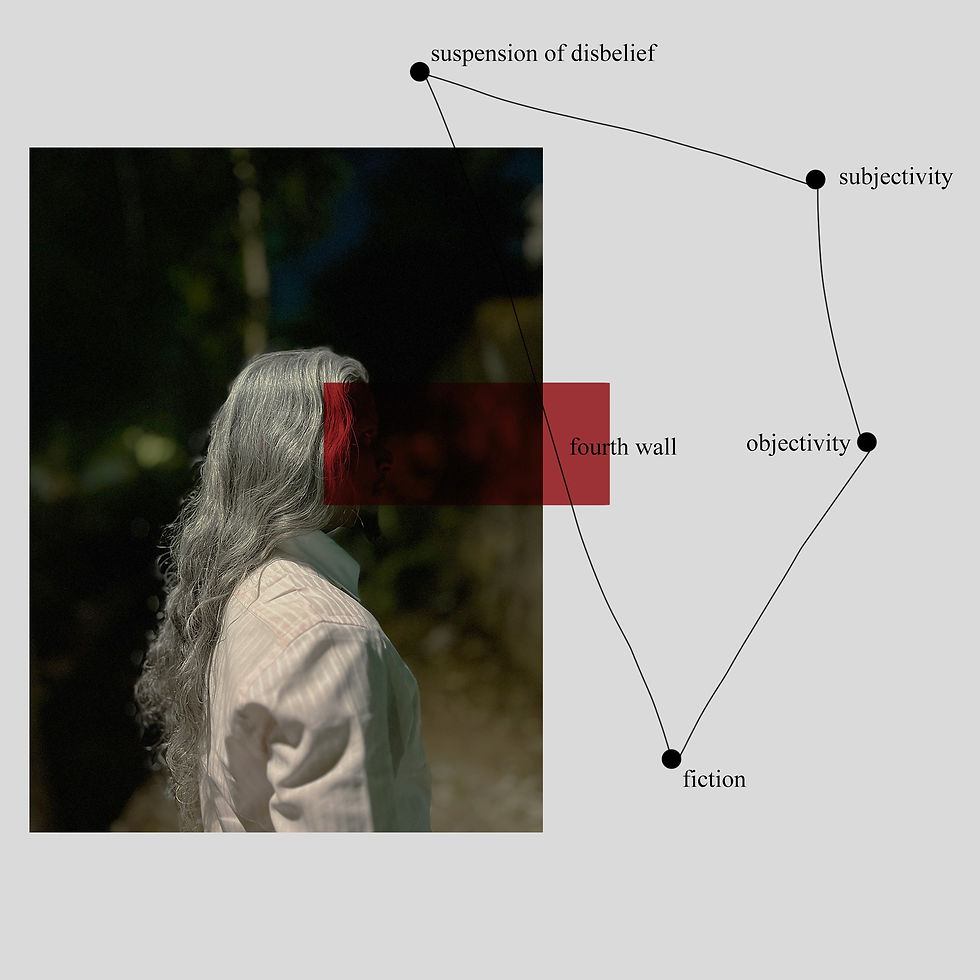

Conversely, when the photographer is "on the stage," they embrace what Goldberg (2011) describes in the context of performance art: the artist’s presence becomes the medium itself. Here, the "creator" is no longer a detached observer but a participant in a spontaneous "life process." This mirrors the theatrical concept of liminality, where the artist occupies a threshold between being the master of the narrative and a subject of the moment’s unpredictability (Turner, 1982). Ultimately, the photographer does not choose one side; they exist in a state of "theatricality," where the act of seeing is simultaneously an act of being seen.
The photographer’s navigation between being "on the stage" and "creating the stage" ultimately hinges on a continuous, internal suspension of disbelief. To engage the visual narrative, the practitioner must oscillate between the roles of the architect who knows the artifice and the observer who believes the fiction.
References
Fried, M. (1980). Absorption and theatricality: Painting and beholder in the age of Diderot. University of California Press. (Discusses the artist's ability to create a world that ignores the viewer).
Goldberg, R. (2011). Performance art: From Futurism to the present. Thames & Hudson. (Explores the artist's role as a physical participant within the creative act).
Turner, V. (1982). From ritual to theatre: The human seriousness of play. PAJ Publications. (Examines the "liminal" state where the creator loses themselves in the process).


Comments